
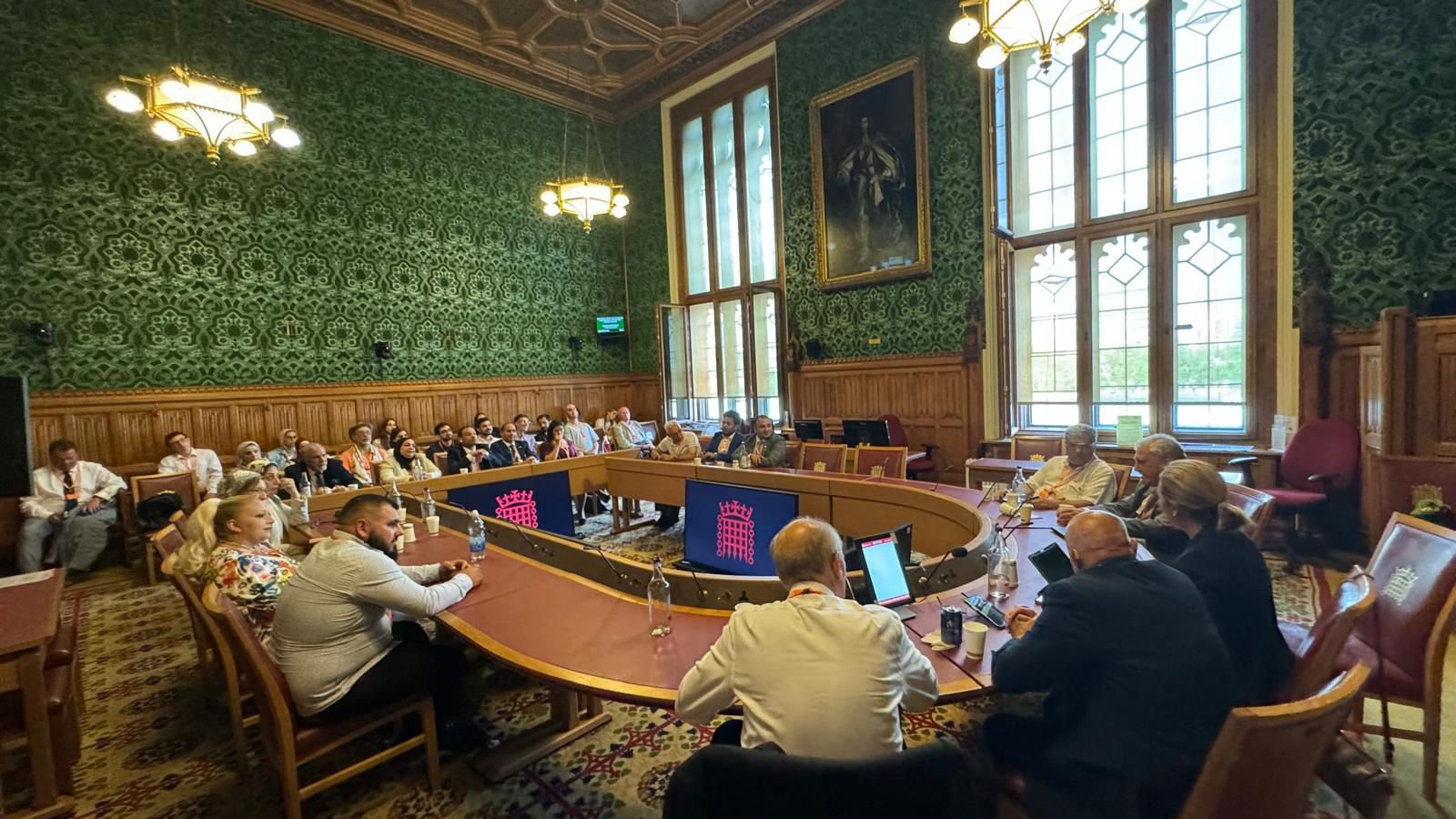
London, 1 July 2025 — At a thought-provoking policy forum held in Committee Room 3A of the House of Lords, legal scholar and Arab Lawyers Association President Sabah Al-Mukhtar delivered a searing and historically rich critique of British-Arab relations, warning that the long legacy of imperial interference, deception, and double-dealing continues to shape the Middle East to this day.
The event, “Revisiting the History of British-Arab Relations – Opportunities & Challenges”, was hosted by The Rt Hon Lord Jackson, and brought together politicians, journalists, lawyers, and community leaders to reflect on the legacy and future of UK-Arab engagement.
Al-Mukhtar began by calling the history between Britain and the Arab world “long and complex,” yet succinctly highlighted key moments where British policy left lasting damage in the region.
“The first encounter was when in the 11th and 13th centuries the Crusaders went to fight the infidels. Some people think it still is,” he remarked sharply, drawing attention to persisting colonial mindsets.
A Catalogue of Colonial Intrusions
His address outlined a sweeping chronology of British involvement in the Arab world — from the Sykes-Picot Agreement of 1916, which secretly divided Arab lands between Britain and France despite prior promises of Arab independence, to Britain’s contradictory support for both the Hashemites and Al Saud during the post-Ottoman reshuffling of the Arabian Peninsula.
“This was the first criminal deception in the relationship,” Al-Mukhtar said, referring to the simultaneous signing of the Sykes-Picot agreement and the Hussein-McMahon correspondence. “Arab countries, 110 years later, are still reeling from it.”
He described British policy in the 20th century as often exploitative, citing the British mandate over Palestine and Iraq, its role in delimiting borders between Iraq and Iran, and involvement in invasions of Egypt (1956), Iraq (1991, 2003), and ongoing support for actions that he implied contravene international law.
“In 2003, Britain under Tony Blair joined the US and the ‘coalition of the willing’ to invade Iraq using the pretext of weapons of mass destruction,” he noted, drawing a parallel to rising tensions with Iran today.
Motivations: Oil, Trade, and Strategy
Al-Mukhtar asserted that Britain’s motives have historically revolved around three core interests: oil, trade, and strategic geographic positioning, particularly in Aden and along the Suez Canal.
Yet he did acknowledge moments where British involvement had some constructive outcomes — notably in Iraq, where Britain played a role in modernizing infrastructure, education, and health services during the 1940s and 50s.
Candid Reflections on Modern Britain
In a deeply personal conclusion, Al-Mukhtar expressed disappointment with the current state of British politics, lamenting the UK’s increasing alignment with U.S. foreign policy and the decision to leave the European Union.
“It pains me to see my adopted country Britain becoming subjected to US influence as if it was an Arab country,” he said. “I’m surprised some English politicians are still fighting the infidels.”
He added, with irony, “We left Europe for the sake of the colour of the passport — which, incidentally, is not really royal blue.”
A Forum for Reflection and Dialogue
The event was part of a broader effort by Orient House, a London-based advocacy group, to foster open discussion around policy, history, and the future of UK-Arab relations. Other speakers included Sam Ammar, former Chairman of Bromsgrove Council; Sam Habeeb, journalist and Director at Orient House; and activist Yousef Qandeel.
The evening offered attendees a rare and candid window into the historical forces that continue to define modern diplomatic and cultural challenges — a necessary step, many agreed, toward more honest and equitable UK-Arab engagement.
For more information or to get involved in upcoming forums, visit www.orienthouse.org.uk or contactinfo@orienthouse.org.uk.